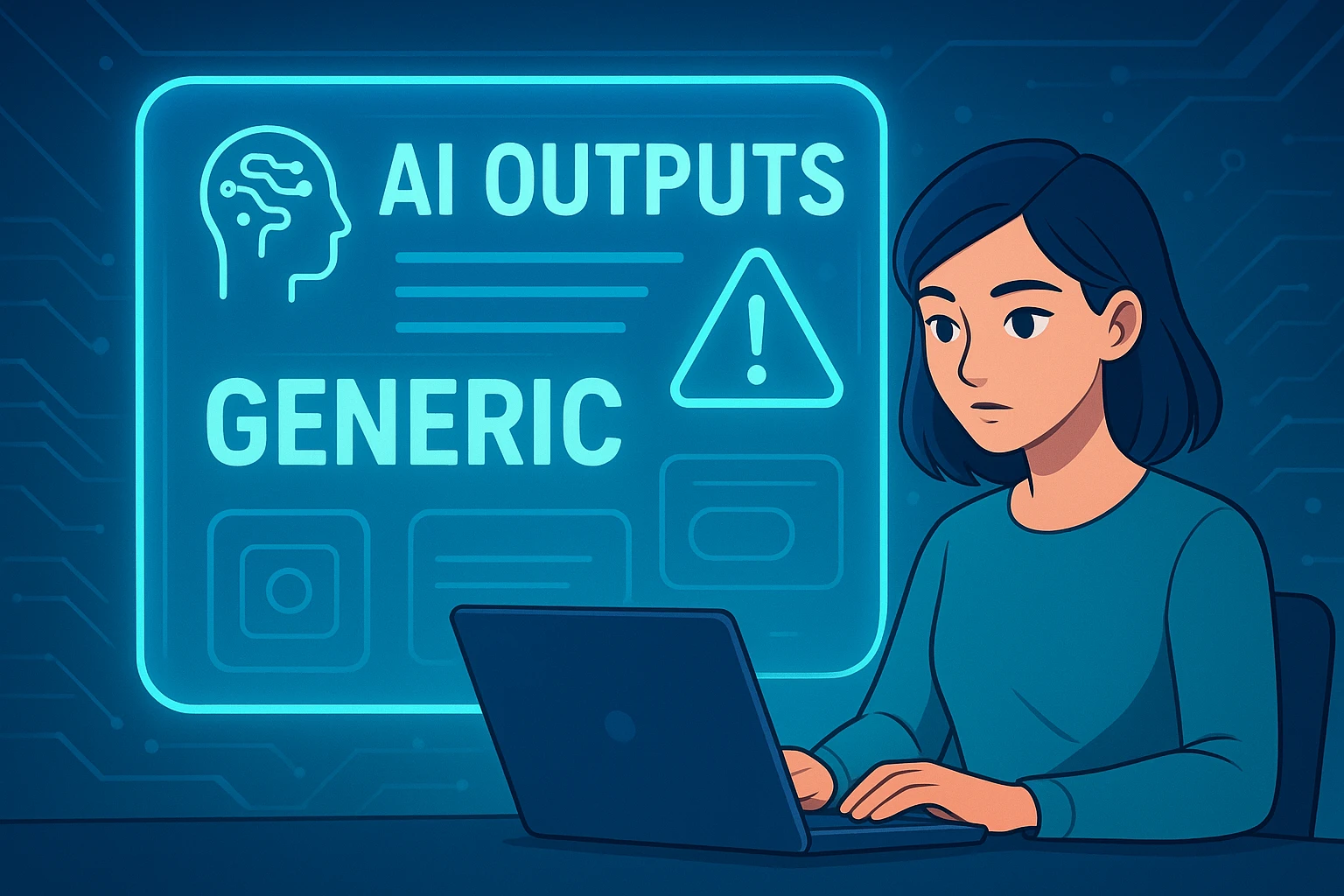
The frustration is real
If you have ever asked an AI to “write something good” and got back something that felt flat, you are not alone. I’ve had that moment too, where the result was technically fine but still sounded like it came from a robot trying very hard to be polite.
The weird part is that the AI usually did what you asked. The problem is that the request was too vague, so the answer had nowhere to go. Generic input almost always leads to generic output.
That is why so many people think AI is underwhelming at first. In reality, the tool is often waiting for better direction.
Why plain prompts lead to plain answers
Think about asking a person, “Can you help me write something?” Most people would need more details before they could do a good job. AI works in a similar way, except it does not stop to ask follow-up questions unless you build them into the prompt.
When the instruction is too broad, the model fills in the blanks with the most average, safe, middle-of-the-road response it can find. That is why you get phrases that sound familiar, repetitive, and forgettable.
Short prompt, short thinking. Clear prompt, clearer output. I learned this the hard way after wasting a lot of time blaming the tool instead of fixing the request.
The pieces that make AI actually useful
Good results usually come from giving the AI a few simple ingredients. You do not need to write like a programmer. You just need to think like someone giving clear instructions to a helpful assistant.
Audience matters because the same message sounds different to a student, a customer, a manager, or a beginner. If you do not say who the content is for, the AI guesses.
Goal matters because “write about this topic” is not enough. Do you want to explain, persuade, summarize, sell, brainstorm, or teach? Each goal changes the result.
Tone matters because “professional” and “friendly” are not the same thing. A post for your business page should feel different from a message to a friend or a school project.
Examples are powerful because they show the style you want. Even one sample sentence can improve the output more than a long explanation.
Constraints are the secret many beginners miss. These are things like word count, format, what to avoid, or what must be included. Constraints help the AI stop wandering.
Audience, goal, tone, examples, and constraints may sound simple, but together they change everything. They turn a vague request into a real direction.
A better prompt in action
Let’s make this practical. Imagine you want AI to help you write a short post for your bakery’s Instagram page.
A weak prompt would be: “Write a post about our bread.” That is not wrong, but it leaves too much open. The AI has to guess the audience, the voice, and the purpose.
A stronger prompt would be: “Write a warm, friendly Instagram caption for local customers who love fresh bread. The goal is to encourage them to visit the bakery this weekend. Keep it under 60 words, make it feel inviting, and mention that the sourdough is baked fresh every morning.”
That version works better because it gives the AI a job, a reader, and rules. It is still simple enough for a beginner, but it is much more likely to produce something usable.
If you want better output, do not ask for “something nice.” Ask for something specific enough that a real person could actually follow it.
Here is another example for school or work: “Explain climate change” is vague. But “Explain climate change in simple terms for a 13-year-old, using one everyday example and no technical terms” gives the AI a much better path.
That is the real shift. You are not just asking AI to create. You are guiding it.
Why this is becoming a must-have skill
We are moving into a world where AI will be used in emails, lesson plans, proposals, product descriptions, videos, research, and daily planning. That means people who know how to ask better questions will save time and get better results.
Prompt engineering is not about sounding technical. It is about learning how to communicate clearly with a tool that can do a lot, but only when you steer it well.
This is not a “nice to have” skill anymore. It is becoming one of those everyday abilities that quietly makes life easier, just like knowing how to write a clear message or search the internet effectively.
The good news is that you do not need to master everything at once. Start by being more specific, add context, and test a few versions. Better prompts almost always lead to better results.
Where to go from here
If you remember only one thing, let it be this: generic prompts create generic outputs. The moment you start adding audience, goal, tone, examples, and constraints, AI becomes much more useful.
That is why learning prompt engineering now is such a smart move. It will help in work, study, business, and content creation, and it will keep paying off as AI tools keep getting better.
The people who get the most value from AI will not be the ones who use it the most. They will be the ones who know how to ask for exactly what they need.
If you are serious about making AI actually useful in your everyday life, now is the time to build that habit.
Leave a Reply