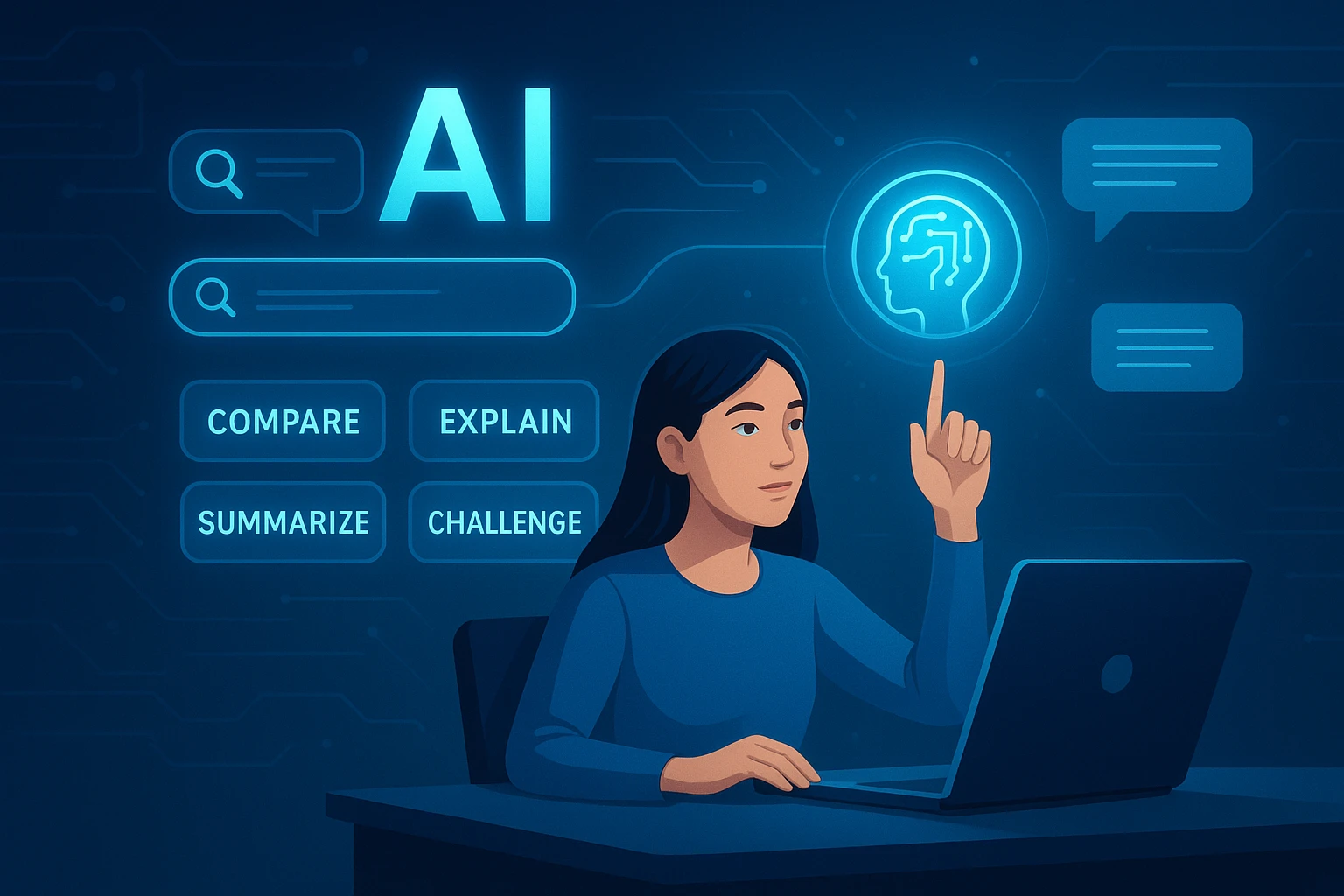
From Searching Links to Having a Real Conversation
For a long time, research meant typing a few words into a search box and opening ten tabs. That still works, but it often feels like digging through a giant pile of notes just to find one useful sentence.
AI changes that experience. Instead of making you hunt for information one page at a time, it can talk back, ask questions, and help you move faster. That shift matters because most people do not need more links—they need clearer understanding.
I have seen this change in small everyday moments. A student trying to understand a topic, a manager comparing tools, or a small business owner checking what customers really want all benefit more from a conversation than from a list of blue links.
Research is becoming less about collecting information and more about shaping it into something you can actually use.
What AI Can Help You Do With Information
The most useful part of AI is not that it finds things. It is that it can work with information in ways that save time and mental energy.
For example, it can compare two ideas side by side, summarize a long article into a few simple points, and simplify complicated language so it sounds normal again. It can also help you spot what is missing, which is often the part people forget.
That last one is huge. A good AI conversation can point out weak arguments, unclear assumptions, or questions nobody has asked yet. In practice, that means you are not just reading faster—you are thinking better.
Here is the real advantage: AI can become your thinking partner. It does not replace judgment, but it can make judgment much easier.
Why Clear Research Goals Matter More Than Ever
Once you start using AI for research, one thing becomes obvious very quickly: vague requests get vague answers. If you ask, “Tell me about social media,” you will get something broad and not very helpful.
But if you ask with a clear goal, the result changes. Try something like, “Compare the best social media platforms for a local bakery trying to attract nearby customers”. Now the answer has a direction.
This is where prompt skill starts to matter. You do not need to sound fancy, but you do need to know what you want, who it is for, and how you want the answer shaped. Those three things can turn random output into useful insight.
The better your question, the more useful the conversation becomes.
Simple Research Workflows You Can Use Right Away
A good way to start is to treat AI like a research assistant who needs instructions. You can ask it to summarize first, then compare second, and then challenge the conclusion.
For example, if you are choosing between two online courses, you could ask: “Summarize the main differences in plain language, compare the pros and cons for a beginner, and tell me what might be missing from each course description.” That one request can save you from hours of back-and-forth reading.
Or imagine you are writing a blog post. You might ask AI to explain the topic simply, then find gaps in the outline, and finally suggest questions a reader would still have. That gives you a much stronger draft than simply asking for “an article about X.”
In business, the same method works for product research, customer feedback, and competitor analysis. In school, it works for study notes, essay planning, and checking whether you really understand the topic.
Here is a simple flow I keep coming back to: ask for a summary, ask for a comparison, ask for gaps, then ask what should be questioned. It sounds basic, but it is surprisingly powerful.
Better Questions Lead to Better Research
The biggest mistake people make with AI is treating it like a search box with extra words. It is much more useful than that, but only if you guide it well.
Research in the future will reward people who can ask clear, smart questions. Not because they know everything, but because they know how to direct the conversation toward what matters.
That is why learning this now is worth it. The people who practice asking better questions today will be the ones who get more value from AI tomorrow. They will save time, make better choices, and understand complex topics faster.
You do not need to become technical to use AI well. You just need to learn how to think clearly, ask carefully, and refine your questions as you go.
That skill will quietly become one of the most useful everyday abilities in work, school, business, and creative life. And once you get used to it, it is hard to go back.
Leave a Reply