When Every Choice Starts to Feel Heavy
There are days when even small decisions feel tiring. Which email should I answer first? Should I say yes to this project? Is this tool actually worth paying for?
If that sounds familiar, you are not alone. Most people do not struggle because they are lazy; they struggle because they are juggling too many choices with too little clarity.
That is where AI can be surprisingly useful. Not because it will magically pick the right answer for you, but because it can help you see the decision more clearly.
The real value is not in getting an answer faster. It is in understanding the options better before you choose.
A Simple Way to Use AI When You Need to Decide
I have found that the best way to use AI is like asking a very organized friend to help you think out loud. You give it the situation, the goal, and the limits, and it helps break the problem into pieces.
Instead of asking, “What should I do?” try asking, “Help me compare these choices based on cost, time, and effort.” That one shift changes everything.
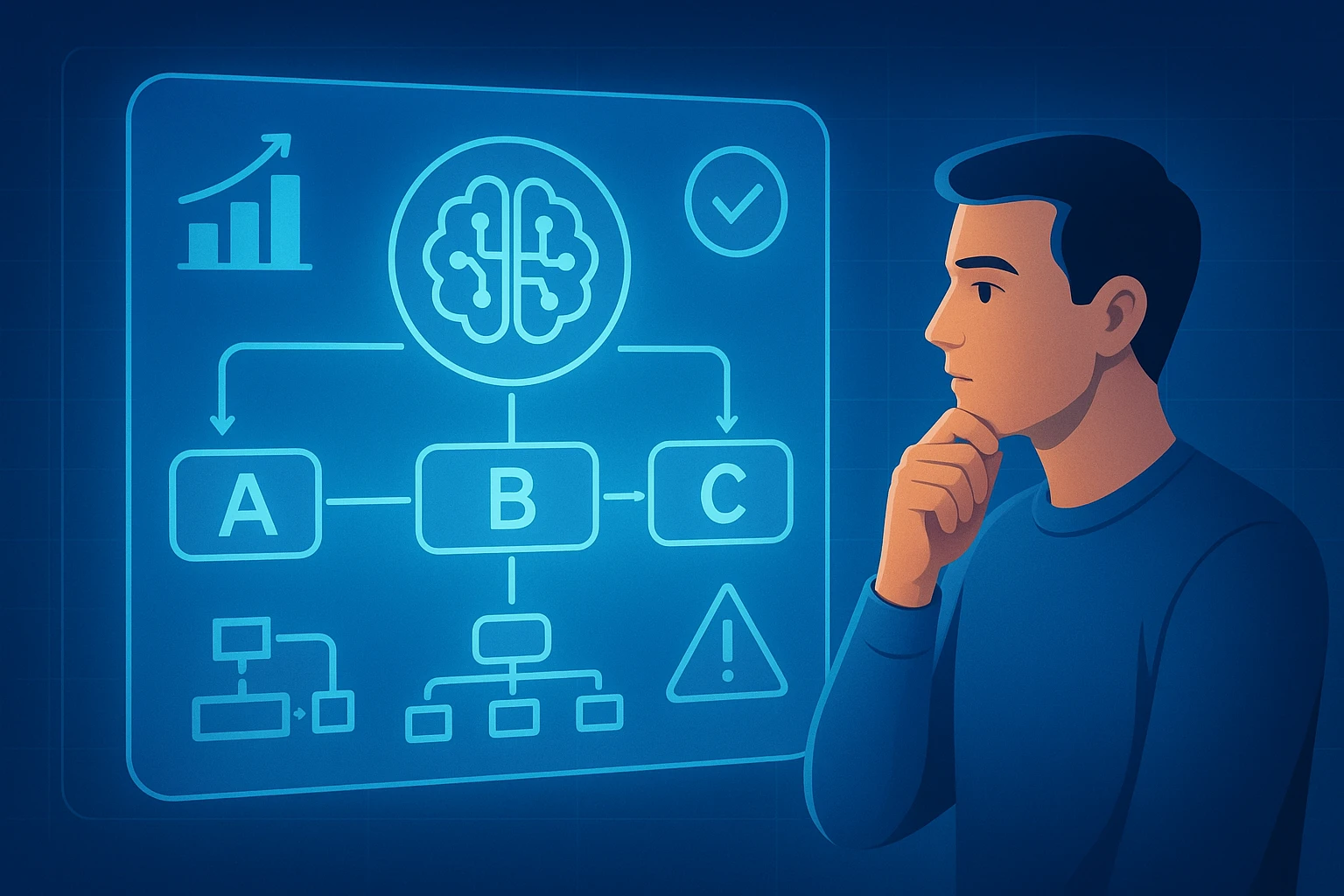
AI works best when you use it in a decision workflow rather than as a fortune teller. First, describe the situation. Then ask for options. Then ask for trade-offs. Then ask what might be missing.
This is helpful in everyday life too. Choosing a phone plan, deciding whether to take a course, planning a marketing idea, or figuring out how to spend a limited budget all become easier when the problem is laid out clearly.
What AI Can Bring to the Table
One of the most useful things AI can do is expand your view. When we are stressed, we usually think in a narrow way: yes or no, stay or leave, buy or wait.
AI can show you multiple options you may not have considered. It can also help with the boring but important part: listing the pros, the cons, and the hidden risks.
For example, if you are choosing between two job offers, AI can help you compare salary, commute, flexibility, growth potential, and stress level. That does not decide for you, but it does make the choice less blurry.
It can also challenge your assumptions. Maybe you think a bigger option is always better. Maybe you assume a cheaper tool must be worse. AI can ask, “What if the opposite is true?” That question alone can save a lot of regret.
Some of the best decisions happen after your first idea gets politely questioned.
Why Clear Criteria Change Everything
Here is the part people often miss: AI can only help as much as your success criteria are clear. If you do not know what matters most, the answer will feel vague no matter how smart the tool is.
Before asking for help, decide what you actually want. Is it the cheapest option? The fastest one? The one with the least risk? The one that gives the most freedom later?
These constraints matter just as much as the goal. A great option on paper may be useless if it takes too much time, costs too much money, or creates more work than you can handle.
For example, if you are picking a content idea, “best” could mean easiest to make, most likely to get attention, or most useful for your audience. Those are very different answers.
Good inputs lead to better support. That is true with AI, and honestly, it is true with people too.
So instead of asking only for a recommendation, give the tool your boundaries. Say what you can spend, what you cannot do, and what outcome matters most. That is when the help gets really useful.
Better Questions Lead to Better Decisions
The biggest mindset shift is this: AI is not there to be the boss of your choices. It is there to make your thinking sharper, calmer, and more structured.
If you feed it a messy question, you will usually get a messy answer. If you feed it a clear situation, a real goal, and a few honest limits, it can become a very strong decision partner.
That is why learning how to ask better questions is becoming such an important everyday skill. Not someday. Now.
Whether you are planning work, school, business, or personal life, the people who learn to guide AI well will spend less time guessing and more time choosing with confidence. The skill is not just using AI. It is knowing how to direct it.
In the future, the people who get the most from AI will not be the ones who ask the most questions. They will be the ones who ask the right ones.
That is why this is worth learning early. Once you understand how to shape a prompt, you stop treating AI like a toy and start using it like a practical thinking tool. And that changes the quality of every decision that comes after.
Leave a Reply