Why so many AI prompts fall flat
Most people try AI once, get a generic answer, and decide it is not that useful. In my experience, that usually is not an AI problem at all. It is a prompt problem.
A vague prompt is like walking into a store and saying, “I need something helpful.” Helpful for what? For work, school, dinner, marketing, or fixing a messy email? The AI has to guess, and when it guesses, the result usually feels thin, obvious, or strangely off.
Weak instructions create weak results. That is the part many beginners miss at first. The good news is that you do not need to be technical to improve fast. You just need a simple habit for checking your prompt before you press send.
The 10-second check I use before sending a prompt
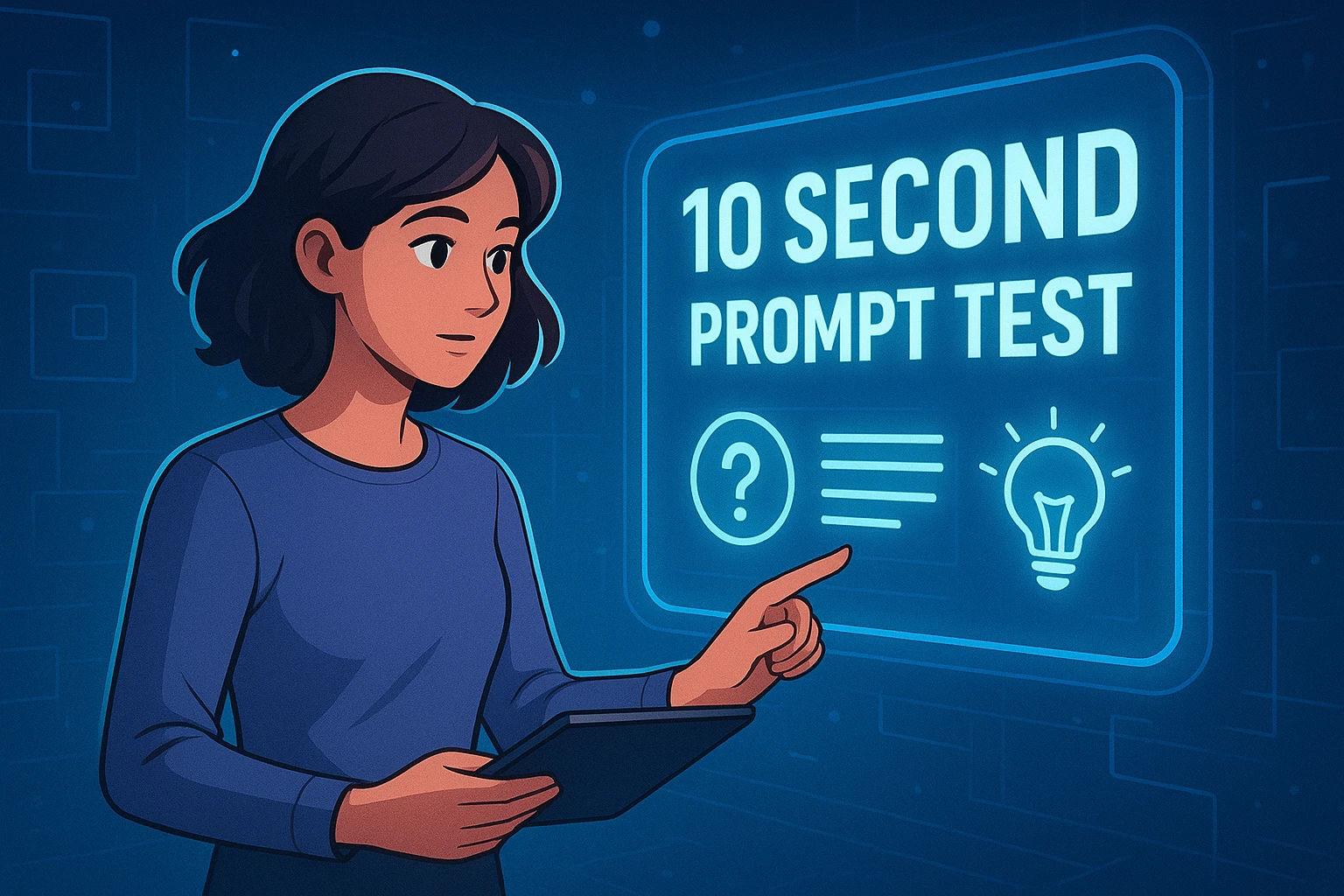
I like a quick mental test: goal, context, output, constraints. If your prompt is missing one of these, it often needs more work. This takes about 10 seconds once you get used to it.
Goal means: what do you want the AI to help with? Context means: what does it need to know about your situation? Output means: what should the answer look like? And constraints means: what rules should it follow?
Good prompts do not have to be long. They just need to be clear enough that the AI does not have to read your mind. That alone can change the quality of the answer dramatically.
If a prompt feels too simple, it is often because it is missing one of these four pieces.
A weak prompt and a stronger one
Here is a common example: “Write a post about healthy eating.” This is not terrible, but it is very broad. The AI could give you something aimed at athletes, parents, students, or people trying to lose weight, because it has no clue who the message is for.
A stronger version might be: “Write a friendly 300-word social post about healthy eating for busy office workers who skip lunch. Keep it practical, use simple language, and give 3 easy ideas they can try this week.”
See the difference? The second prompt gives goal, context, output, and constraints. That helps the AI narrow its focus and produce something much more useful.
Here is another everyday example: “Help me study for history” is weak. “Quiz me on the causes of World War I with 10 short questions, and explain each answer in simple language” is much better.
The second one is not fancy. It is just specific. And specific almost always wins.
Why clearer prompts lead to better results
AI tools are good at working with patterns, but they are not good at reading vague intentions. When your request is broad, the tool has to fill in the blanks, and those blanks often become the problem.
Clarity helps the AI understand your purpose. Specificity helps it choose the right angle. Limits help it stay useful instead of wandering off into a long answer that sounds polished but does not help much.
Think of it like giving directions to a person who wants to help you. If you say, “Go somewhere useful,” you will not get very far. If you say, “Go to the pharmacy on Main Street, pick up pain relief medicine, and come straight back,” now the path is obvious.
This matters in daily life, work, school, business, and content creation. The same AI can be a great brainstorming partner, a study helper, a writing assistant, or a planning tool, but only if you tell it what kind of help you actually want.
Better prompts save time. They also reduce frustration, because you spend less time correcting the AI and more time using the answer.
Prompt skill is becoming a basic life skill
We are moving into a world where AI will be built into more and more tools we already use. Email, documents, search, customer support, design, learning platforms, and business software are all getting AI features. That means knowing how to ask for the right thing will matter everywhere.
Prompt engineering sounds fancy, but the real skill is simple: learning how to ask clearly. If you can explain a task to a person, you can learn to explain it to an AI.
This is not a niche skill for tech people anymore. It is becoming a normal part of being effective in modern work and everyday life. The people who learn it early will feel more confident, faster, and more in control when using AI tools.
That is why I would not wait to start. The sooner you practice, the sooner AI stops feeling random and starts feeling genuinely useful.
Where to start if you want better prompts now
If you want better results, start with the 10-second test every time: What is the goal? What context matters? What output do I want? What limits should I set?
Then try improving one weak prompt today. Add just one missing piece, then compare the result. That small habit teaches you more than a dozen random trials.
The fastest way to get better is to see examples of weak prompts and strong prompts side by side. Once you notice the pattern, you will spot bad prompts almost instantly.
And honestly, that is the moment AI starts feeling less like a novelty and more like a real tool you can count on.
Leave a Reply